


Security position
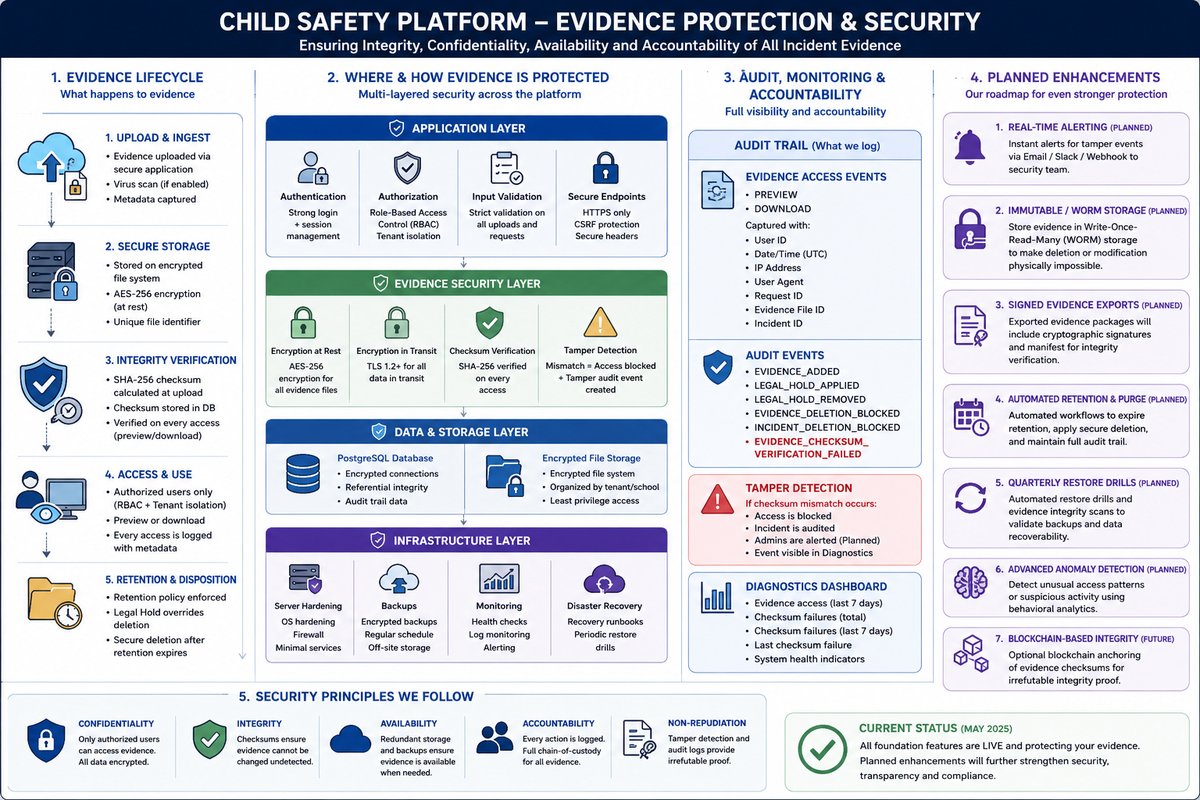
Child Protect Platform is designed for sensitive safeguarding workflows where confidentiality, integrity, availability, accountability, and recoverability matter. Security is treated as a lifecycle requirement across intake, storage, access, audit, backup, and recovery.
Evidence handling
- Evidence is associated with the correct report, tenant, school, and user context.
- Access is mediated through authenticated application workflows.
- Uploaded files may be scanned for malware before being trusted by normal workflows.
- Evidence access, downloads, administrative actions, and file associations can be logged.
- Preservation discipline is preferred over informal deletion or uncontrolled file sharing.
Encryption and data protection
The platform is designed to support encryption for sensitive evidence at rest and HTTPS/TLS for public web traffic. Encryption is paired with application-level authorization, tenant and school scoping, audit logs, and operational security controls.
Hardened hosting model
A recommended production deployment uses a hardened server model: HTTPS via nginx or equivalent reverse proxy, local-only application and database ports, firewall default deny, hardened SSH, security headers, brute-force protection, monitoring, backup verification, and controlled service management.
Auditability
Important events can be recorded, including user creation, account locking, reset-link issuance, role changes, tenant and school changes, case updates, evidence uploads, evidence access, and security/operational events. Auditability helps organizations answer who acted, when, under what role, and within what scope.
Backup, restore, and disaster recovery
Backups are only valuable if they can be restored. The platform's operational model should include database backup verification, evidence storage recovery planning, configuration backup, restore testing, health checks, and documented recovery procedures.
Security boundaries
No system can guarantee absolute security. Customers remain responsible for selecting authorized users, assigning correct roles, training staff, maintaining local policies, securing endpoints, reporting incidents, and avoiding unauthorized exports or disclosure.
This page explains how Child Protect supports secure evidence handling through controlled uploads, restricted access, audit trails, encryption, backup discipline, and accountable review workflows.
Thailand PDPA official text · Child Protection Act text hosted by MOE · MOE SAFE SCHOOL announcement · MOE Safety Center information