


School safeguarding software
Child Protect Platform is school safeguarding software built in Thailand for Thai and international schools. It gives a safeguarding lead one structured place to receive concerns (including anonymous reports by QR code), protect child-related records and evidence, manage who can see each case, and show a clear history of every action.
For schools
How does Child Protect help individual schools?
Child Protect helps a school move safeguarding concerns from informal communication into a structured case workflow. It supports consistent reporting, controlled access, evidence attachment, action tracking, and safer handover when staff responsibilities change.
Common questions
Can teachers submit concerns?
Authorized staff can be given a structured way to report concerns so safeguarding leads receive more complete information.
Can access be restricted?
Yes. Role-based access helps ensure sensitive records are visible only to people who need them.
Can evidence be attached?
Yes. Relevant files and notes can stay connected to the correct case rather than being spread across inboxes or folders.
Is it only for large schools?
No. The same structured approach can support small schools, large schools, and specialist safeguarding teams.
A stronger brochure your team can actually use.
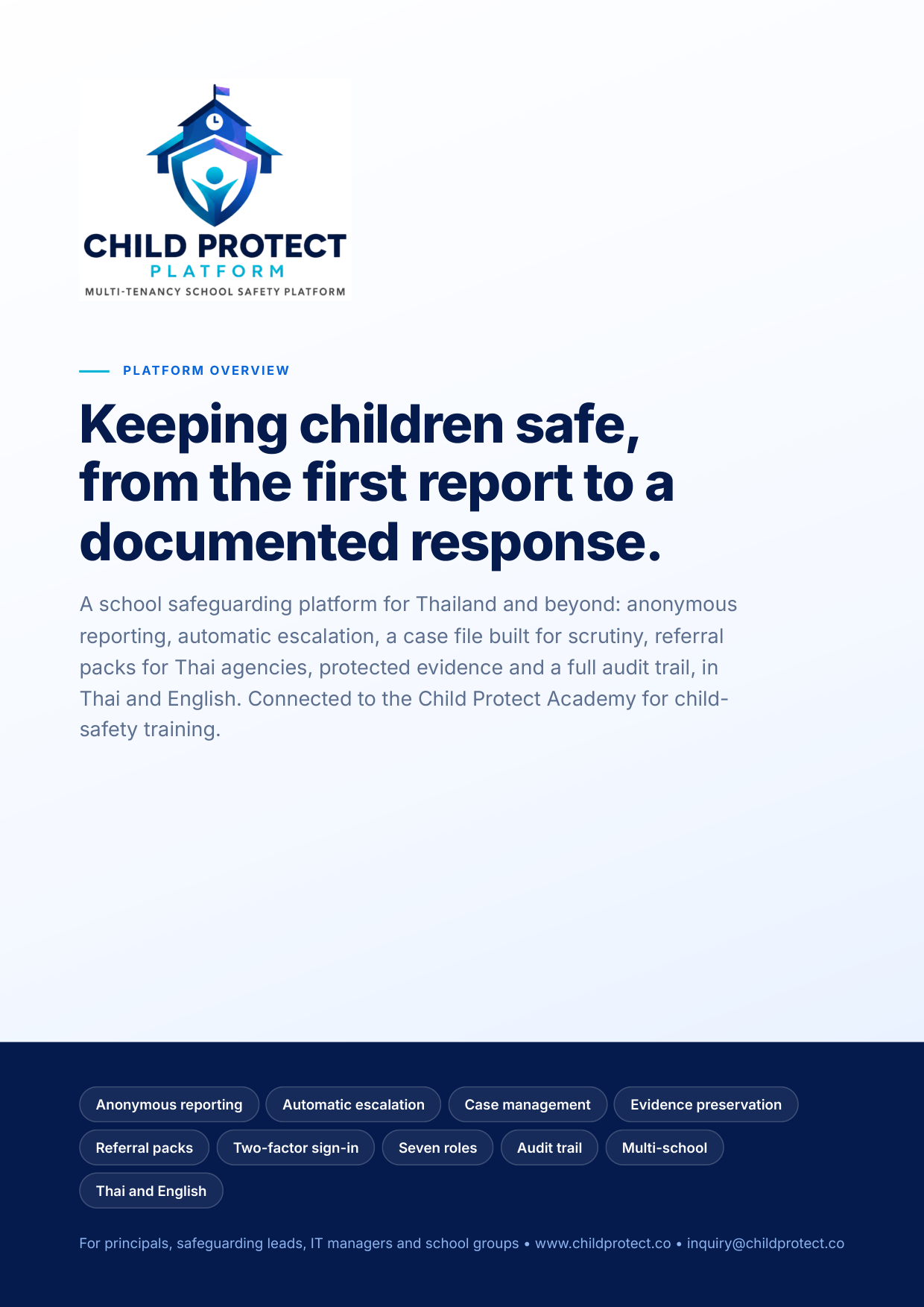
Download the expanded Child Protect Platform overview for principals, safeguarding leads, IT managers, and education group decision makers. The brochure explains why schools need a system, the Safeguarding Lifecycle, anonymous reporting, automatic escalation, the case file, evidence and security, referrals, PDPA and Thai rules, the Child Protect Academy, implementation, pricing and what is coming next.
Desktop, tablet, and mobile ready.
Child Protect Platform is designed for modern web browsers, giving administrators, safeguarding teams, and school users responsive access from desktop, tablet, and mobile devices without requiring a separate app.
Built for the way safeguarding teams actually work.
Schools need more than a contact form. Safeguarding work involves sensitive children’s information, evidence, review notes, role boundaries, school leadership, and future accountability.
Structured concern reporting
Capture concerns through a controlled workflow instead of scattered email threads, messaging apps, paper notes, or shared spreadsheets.
Encrypted evidence handling
Uploaded evidence is connected to the right report, school, tenant, and user context with access control, preservation discipline, and audit-ready handling.
Clear review history
Safeguarding leads and authorized reviewers can maintain case status, notes, actions, and decision history in one controlled environment.
Why Thai schools should not rely only on email and shared drives.
Informal tools can be convenient, but they are not designed for safeguarding evidence, controlled access, school-level scoping, or later review.
Designed for school leaders, safeguarding teams, and administrators.
Each role receives access appropriate to its responsibility, reducing unnecessary exposure while supporting faster action.
| School role | How Child Protect helps |
|---|---|
| School leadership | Provides a clearer governance view of safeguarding activity, accountability, evidence handling, and operational readiness. |
| Safeguarding leads | Supports triage, review, notes, status tracking, assignment, and preservation of supporting material. |
| Investigators | Allows authorized case work and evidence review within the correct school or tenant scope. |
| Reporting staff | Provides structured reporting without giving unnecessary access to broader sensitive case material. |
| IT and operations | Supports hardened hosting, health checks, backups, malware scanning, and controlled deployment practices. |
| Auditors and reviewers | Supports accountability through reviewable records, audit trails, and controlled access to relevant history. |
Key capabilities for schools in Thailand.
The platform is positioned for schools and education groups that need secure safeguarding operations and practical alignment with Thailand-focused data protection and school safety expectations.
PDPA-aware data handling
Designed to support responsible handling of personal data, sensitive records, controlled access, retention discipline, and secure processing.
View Privacy PolicyChild data safeguarding notice
Explains how child-related safeguarding information and supporting evidence should be collected, protected, shared, and retained.
View Child Data NoticeThai education alignment
Supports school safety workflows, controlled reporting, record preservation, and accountable response practices for education environments.
View Education AlignmentSecurity & evidence preservation
Highlights encryption, role-based access, malware scanning, audit records, hardened hosting, backup discipline, and operational assurance.
View Security StatementSchool safeguarding lifecycle
A staff member submits a concern through a structured intake process.
Authorized safeguarding personnel review severity, status, responsibility, and next action.
Documents, screenshots, images, CCTV-related materials, or statements can be linked to the right case.
Notes, actions, access events, status changes, and evidence context remain available for review.
What makes it different
Child Protect Platform is not a generic helpdesk, shared drive, or form builder. It is a safeguarding operations platform designed around secure intake, tenant and school separation, role-based access, encrypted evidence preservation, audit logging, and production security controls.
Give your school a safer safeguarding workflow.
Request a focused briefing for principals, school owners, safeguarding leads, IT teams, or education group administrators.
Related safeguarding topics
Explore related workflows that help schools connect reporting, case management, evidence, access control, and training.
Implementation and buying guides
These guides help schools move from evaluation to practical rollout: selecting safeguarding software, preparing implementation responsibilities, and improving structured reporting workflows.